12 Surprising Ways AI Regulation Differs in the USA, UK and Europe
AI regulation in the USA, UK and EU compared: 12 key differences in laws, bans, fines and enforcement, with real cases any business should understand.
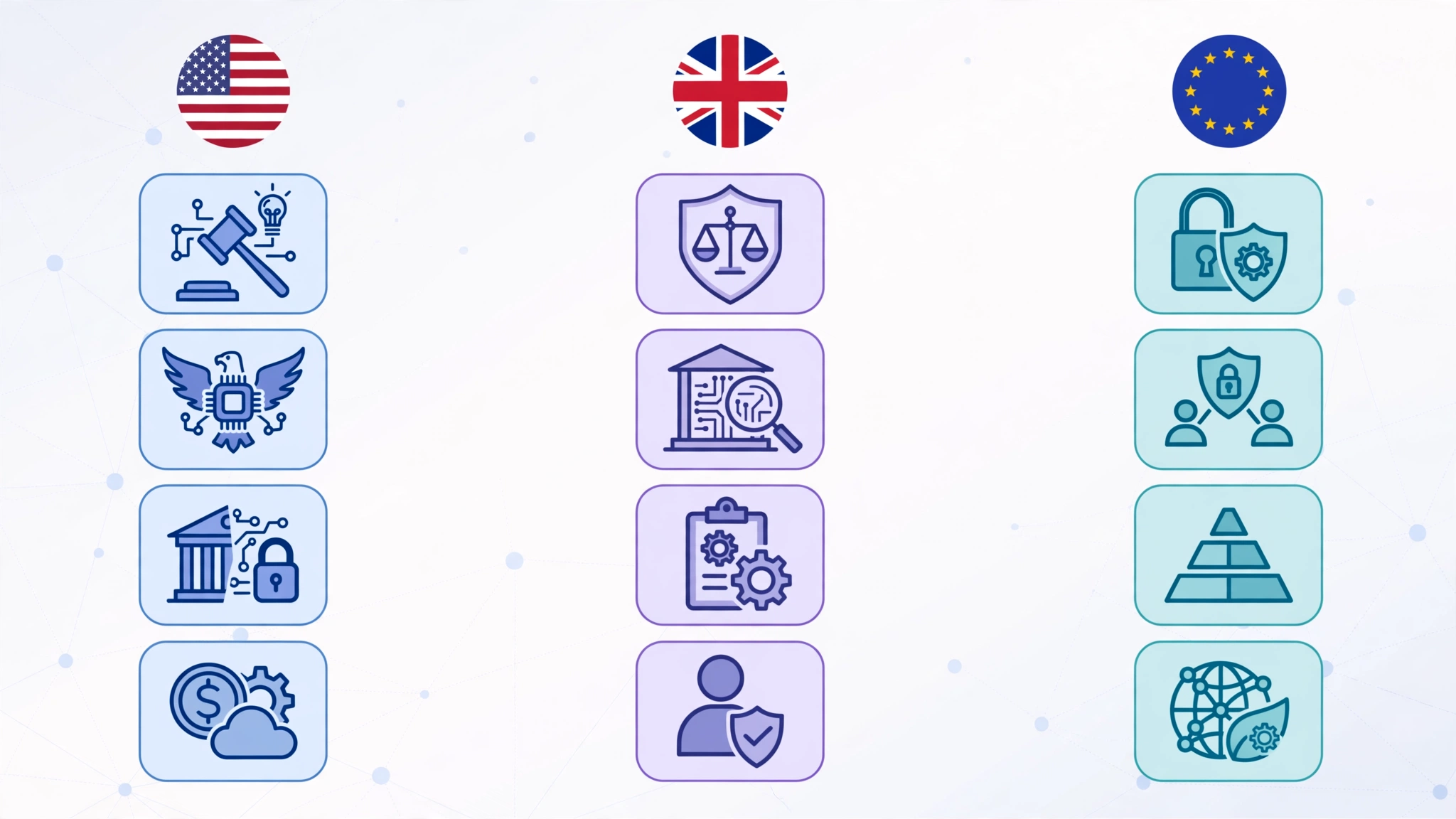
12 Surprising Ways AI Regulation Differs in the USA, UK and Europe
Introduction: Why AI Regulation Looks So Different Across the Atlantic
AI regulation now depends heavily on where your customers live. Picture one hiring tool used by one company. In Germany, it will soon count as a high-risk system under the EU AI Act, with testing, documentation and human oversight required by December 2027. In Colorado, the same tool will need consumer notices and a route to human review from January 2027. In London, there is no AI-specific law at all, just data protection, equality and consumer rules that already applied before AI arrived.
That is the reality for businesses heading into 2027. Europe has written one detailed rulebook. The United Kingdom has chosen a lighter, principles-based approach and keeps postponing a dedicated AI bill. The United States has no federal AI law, more than a hundred state laws, and a White House actively trying to override many of them.
This article walks through 12 differences in AI regulation across the USA, the UK and Europe that often surprise business owners. Each one shows how the three systems treat the same problem, from banned uses and hiring algorithms to deepfakes, copyright and fines. Each also includes a real case where an AI system crossed a legal or ethical line, so you can see why these rules exist and what happens when they are ignored.
This is a practical overview, not legal advice. Rules are moving fast, so check the current position before making compliance decisions.
AI Regulation at a Glance: USA vs UK vs EU
Before the details, here is how the three systems compare on the points that matter most to businesses.
| Area | USA | UK | EU |
|---|---|---|---|
| Main law | No federal AI law; state laws in California, Texas, Colorado, Illinois and others | No AI-specific law; existing regulators apply five principles | EU AI Act (Regulation 2024/1689), amended by the AI Omnibus |
| Overall approach | Innovation first, with federal push to preempt states | Pro-innovation, sector-led | Risk-based rulebook |
| Banned AI uses | Limited (for example, Texas TRAIGA) | None AI-specific | Yes, Article 5 list |
| Hiring and credit AI | State rules, such as Colorado from 1 January 2027 | Data protection and equality law | High-risk rules from 2 December 2027 |
| Frontier models | California SB 53 transparency law | Voluntary testing with the AI Security Institute | General-purpose AI obligations since August 2025 |
| Top penalties | Up to $1 million per violation (California SB 53) | Existing regimes, such as UK GDPR | Up to €35 million or 7% of global turnover |
12 Surprising Differences in AI Regulation
1. One Rulebook, Five Principles, or a Patchwork
The biggest difference is structural. The EU has a single regulation, the EU AI Act, that applies in all 27 member states. The UK has no standalone AI law. Instead, existing regulators apply five principles set out in the government’s 2023 white paper: safety, transparency, fairness, accountability and the ability to challenge decisions. The UK government has promised an AI bill several times, but the King’s Speech in May 2026 included only a Regulating for Growth Bill with regulatory sandbox powers, not a dedicated AI law.
The US sits at the other extreme. There is no federal AI statute, but states have filled the gap. Industry trackers counted about 145 state AI laws passed across 38 states in 2025 alone, covering everything from deepfakes to chatbots.
Why it matters: A business selling across all three markets faces one detailed law, one set of general expectations, and dozens of different state rules. US state AI laws are often the hardest part to track.


2. Who Actually Enforces the Rules
In the EU, enforcement is split between the European AI Office, which oversees general-purpose AI models, and national market surveillance authorities. In the UK, there is no central AI regulator. The Information Commissioner’s Office, the Competition and Markets Authority, the Financial Conduct Authority and Ofcom each apply their own laws, coordinating through the Digital Regulation Cooperation Forum. In the US, the Federal Trade Commission, the SEC and state attorneys general do most of the work, usually with consumer protection laws written long before AI.
Real case: The US approach works through existing law. In 2023, the FTC banned Rite Aid from using facial recognition for five years after its system falsely flagged shoppers as shoplifters, with women and people of color hit hardest. No AI-specific statute was needed; the FTC used its power over unfair practices.
3. The US Government Is Fighting Its Own States
This difference surprises many Europeans. In the US, the federal government is trying to stop states from regulating AI. Congress has failed twice to pass a moratorium, including a 99 to 1 Senate vote in 2025 that stripped one from a budget bill. In December 2025, President Trump signed an executive order creating an AI Litigation Task Force at the Justice Department to challenge state AI laws. In March 2026, the White House asked Congress to preempt state laws it considers unduly burdensome. In April 2026, the Justice Department intervened in a lawsuit against Colorado’s AI law, and in July the FTC proposed a policy statement suggesting Colorado’s revised law may be preempted by federal consumer protection law.
A bipartisan House draft, the Great American AI Act, would add federal frontier model rules and pause some state powers for three years, but it has not been formally introduced. Nothing like this tension exists in the EU or the UK.
Why it matters: Until a court or Congress says otherwise, state AI regulation still applies. Companies must comply with state laws while watching for them to be struck down.
4. Outright Bans on Certain AI Uses
The EU bans a list of practices under Article 5 of the AI Act, including social scoring, untargeted scraping of faces to build recognition databases, emotion recognition at work and in schools, and manipulative AI that causes significant harm. From 2 December 2026, it also bans AI systems that generate non-consensual intimate images or child sexual abuse material.
The UK has no AI-specific bans. The US has a few narrow ones at state level. Texas’s Responsible AI Governance Act, in force since 1 January 2026, prohibits developing or deploying AI with the intent to encourage self-harm, crime or certain other harms, but leaves most uses alone.
Real case: Clearview AI scraped billions of facial images from the internet without consent. EU data protection authorities fined it repeatedly, including €30.5 million from the Dutch regulator in 2024, and its core practice is now explicitly banned under the AI Act. The UK’s ICO fined it £7.5 million in 2022, a penalty that then spent years in appeals over jurisdiction. In the US, Clearview settled an Illinois biometric privacy lawsuit instead.
5. Hiring, Lending and Other High-Stakes Decisions
All three regions worry about AI making life-changing decisions, but they respond very differently:
- EU: AI used in hiring, credit scoring, insurance, education and other Annex III areas is high-risk. From 2 December 2027, providers need risk management, bias testing, documentation, human oversight and conformity assessment.
- US: Colorado replaced its original, EU-style AI Act in May 2026 with SB 26-189, a lighter law effective 1 January 2027. It requires notice before automated decisions in areas like jobs, housing, lending and healthcare, and a right to human review after an adverse outcome, but it dropped mandatory impact assessments. Illinois has required employers to avoid discriminatory AI in hiring since January 2026.
- UK: No AI-specific rule. The Data (Use and Access) Act 2025 relaxed restrictions on automated decision-making, while keeping safeguards such as the right to human intervention.
Real case: In 2018, Amazon scrapped an experimental recruiting tool after finding it downgraded CVs containing the word “women’s.” In the US, a federal court allowed age discrimination claims against HR software company Workday to proceed as a collective action in 2025. Under the EU AI Act, tools like these must be tested for bias before launch.
6. Rules for the Most Powerful AI Models
For frontier AI, the EU requires all general-purpose AI providers to publish training data summaries and copyright policies, and models with systemic risk must undergo evaluations and report serious incidents. The AI Office began sending formal information requests to model providers in August 2026.
In the US, California’s SB 53, in force since 1 January 2026, applies to large frontier developers training above 10^26 operations with more than $500 million in revenue. It requires published safety frameworks, critical incident reporting and whistleblower protections, with penalties up to $1 million per violation. The UK relies on voluntary testing through its AI Security Institute and, according to legal commentators, has rejected proposals for a mandatory emergency “kill switch” for AI models.
Why it matters: Frontier model AI governance is binding in the EU and California, but voluntary in the UK and at US federal level.
7. Copyright and AI Training Data
The three regions disagree sharply on whether AI companies can train on copyrighted material:
- EU: Commercial text and data mining is allowed unless rights holders opt out, and general-purpose AI providers must have a copyright policy and publish a summary of their training content.
- UK: The only text and data mining exception covers non-commercial research. In March 2026, the government dropped its preferred plan for an EU-style opt-out exception, made no final decision, and is reportedly pushing reform into 2027. For now, commercial AI training in the UK generally needs a licence.
- US: There is no specific rule. Courts decide case by case under fair use, and in September 2026 the Justice Department filed a statement supporting OpenAI’s fair use argument in the New York Times case.
Real case: In 2025, Anthropic agreed to pay $1.5 billion to settle a US class action from authors who said it downloaded pirated books to train its models, and the settlement won final approval in July 2026. The case shows that even in the more permissive US system, using pirated material is a costly mistake. AI copyright rules remain the least settled part of AI law in all three places.
8. Deepfakes and AI-Generated Content
All three regions now act against harmful deepfakes, but through different tools:
- EU: Article 50 of the AI Act requires machine-readable marking of AI-generated content and disclosure of deepfakes, with the marking deadline for existing systems on 2 December 2026.
- US: The federal TAKE IT DOWN Act, signed in 2025, makes publishing non-consensual intimate images, including AI-generated ones, a crime and requires platforms to remove them within 48 hours of a valid request. California’s AI Transparency Act requires large generative AI providers to offer watermarks and detection tools.
- UK: The Online Safety Act requires platforms to tackle illegal content, and the Data (Use and Access) Act 2025 made creating sexually explicit deepfakes of adults without consent a criminal offence.
Real case: In January 2026, the European Commission opened a formal investigation into X under the Digital Services Act after sexually explicit manipulated images and possible child abuse material made with its Grok tool spread on the platform. In the US, a 2024 robocall used a fake Joe Biden voice to tell New Hampshire voters to skip a primary, and the FCC fined the consultant behind it $6 million. Deepfake laws are one area where all three regions are moving in the same direction.
9. The Size of the Fines
Penalties show the gap in ambition most clearly. Under the EU AI Act, using a banned practice can cost up to €35 million or 7% of global annual turnover. Colorado’s new law allows penalties of up to $20,000 per violation, enforced only by the state attorney general after a 60-day cure period. California’s SB 53 allows up to $1 million per violation. The UK has no AI-specific penalties, but the UK GDPR allows fines up to £17.5 million or 4% of global turnover.
Real case: The EU’s data protection track record shows how turnover-based fines can scale. In 2023, Ireland’s Data Protection Commission fined Meta €1.2 billion over data transfers to the US. If the AI Act is enforced the same way, its penalties will dwarf most US state fines.
10. Old Consumer Laws Doing New Jobs
In the US and UK, consumer protection law often does the work that AI-specific law does in Europe. The FTC’s Operation AI Comply in 2024 targeted companies making false AI claims, including DoNotPay, which agreed to pay $193,000 over its “robot lawyer” marketing. The SEC fined two investment advisers $400,000 in total that year for AI washing. In the UK, the Digital Markets, Competition and Consumers Act 2024 lets the CMA fine companies directly for unfair consumer practices, including misleading AI claims.
There is a twist in the US, though. The FTC’s July 2026 proposed policy statement signals a shift toward using federal consumer law to challenge state AI rules, not just to police companies.
Real case: In 2024, a Canadian tribunal ordered Air Canada to honor a refund policy its chatbot had invented. Similar disputes in the UK or US would usually be decided under ordinary contract and consumer law, not AI law.
11. Sandboxes and the Push for Growth
Every region now talks about innovation, but in different tones. The UK is the most growth-focused: its Regulating for Growth Bill, announced in May 2026, gives departments power to scrap outdated rules and set up AI sandboxes. The US federal government has removed most Biden-era AI rules, starting with a January 2025 executive order, and in June 2026 set up voluntary federal reviews of frontier models. The EU, despite its reputation, has also softened: the AI Omnibus delayed high-risk duties, extended relief to small mid-cap companies, and requires every member state to run an AI regulatory sandbox by 2 August 2027.
Why it matters: The pro-innovation approach is now shared across all three. The difference is whether it comes with binding rules attached.
12. How Predictable the Rules Are
The final difference is stability. EU rules now have fixed dates written into law. US federal AI policy swings with each administration: President Biden’s 2023 AI executive order was revoked within days of the change of government in January 2025, and state laws are being rewritten or challenged in court. The UK has postponed its AI bill repeatedly since 2024, leaving businesses to guess what comes next. Military and national security uses also differ: the EU AI Act excludes them entirely, while in the US they have become a political flashpoint, as shown by the Pentagon’s 2026 dispute with Anthropic over limits on surveillance and autonomous weapons use.
Why it matters: Predictability is a business asset. For compliance planning, the EU is the strictest but also the easiest to plan for.
How to Handle AI Regulation in All Three Markets
You do not need three separate compliance programs. Most businesses can build one program around the strictest rules and adjust at the edges.
- Use the EU AI Act as your baseline. If your AI meets EU standards for risk management, documentation and human oversight, you will cover most of what Colorado and the UK regulators expect.
- Map where your users are. US state rules depend on where customers live, not where your company is based. Track Colorado, California, Texas and Illinois at a minimum.
- Keep a single AI inventory. List every AI system, what it decides, what data it uses and which markets it touches.
- Treat hiring and lending AI as high-risk everywhere. All three regions scrutinize these uses, through AI law in the EU and anti-discrimination law in the UK and US.
- License your training data. The UK requires licences for commercial text and data mining, and US settlements show the cost of pirated data.
- Watch the US preemption fight. A federal law or court ruling could wipe out some state duties, but until that happens, they apply.
- Use a common framework. The NIST AI Risk Management Framework maps well to both EU and UK expectations.
For primary sources, the European Commission’s AI Act page covers the EU rules and official guidance, and the UK government’s pro-innovation approach to AI regulation white paper sets out the five principles UK regulators apply.
Conclusion
AI regulation in the USA, UK and Europe shares the same goals of safety, fairness and trust but reaches them in very different ways: the EU has one binding, risk-based AI Act with bans, high-risk duties from 2 December 2027 and fines up to 7% of global turnover; the UK relies on existing regulators, five principles and repeated promises of an AI bill that has not arrived, while choosing growth, sandboxes and a licence-based approach to copyright; and the US has no federal AI law, a fast-growing patchwork of state laws in places like California, Colorado and Texas, and a federal government actively trying to preempt them. Real cases, from Clearview AI’s face scraping and Amazon’s biased hiring tool to Rite Aid’s false facial recognition matches, Anthropic’s $1.5 billion pirated books settlement and the Grok deepfake investigation, show that harmful AI gets punished in all three places, just through different laws, so the safest strategy for any business is to build to the strictest standard, track where its users live, and treat transparency, fairness and lawful data as non-negotiable wherever it operates.