OpenAI vs Google vs Anthropic 7 Critical Battles Shaping the AI Race in 2027
OpenAI vs Google vs Anthropic: a look at the 7 battles over models, compute, money, customers, courts and safety that will decide the AI race in 2027.
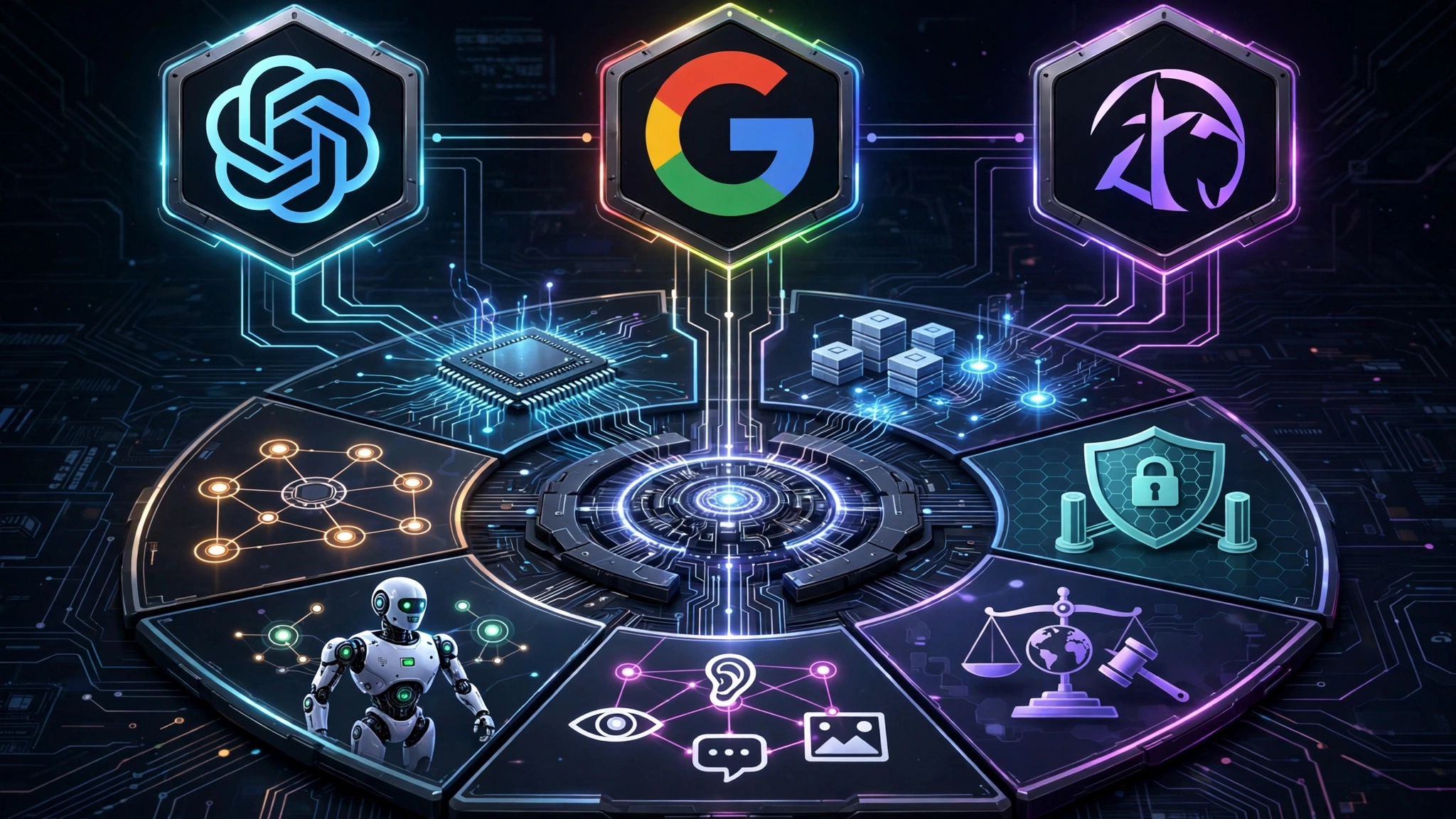
OpenAI vs Google vs Anthropic: 7 Critical Battles Shaping the AI Race in 2027
Introduction: Why OpenAI vs Google vs Anthropic Is the Rivalry That Matters
OpenAI vs Google vs Anthropic is no longer a debate about which chatbot writes the best email. By late 2026 it has become a contest of trillion-dollar valuations, gigawatt data centers, federal lawsuits and fights with governments. OpenAI closed new funding at a $1.25 trillion valuation in November. Anthropic listed on Nasdaq the same month. Google, meanwhile, is appealing a court ruling that found it ran an illegal search monopoly, while shipping its strongest Gemini models yet.
The headlines make this look like a simple scoreboard. It is not. Each company is winning some battles and losing others, and each carries legal and ethical baggage that could slow it down. OpenAI faces a sanctions fight in its copyright case with The New York Times. Google has paid billions in European antitrust fines. Anthropic paid $1.5 billion to settle claims that it trained on pirated books, and it is still in court with the Pentagon.
This article breaks the AI race 2027 into seven battles: frontier models, compute, money, enterprise customers, distribution and antitrust, copyright, and safety and government. For each one, you will see where the three companies stand today, what to watch next year, and the real legal record behind the marketing. No cheerleading, just the facts and what they mean for businesses and users choosing between these platforms.
The 7 Critical Battles in OpenAI vs Google vs Anthropic
Each battle below covers where things stand in November 2026, what to expect in 2027, and a reality check from the legal or ethical record.
Battle 1: The Frontier Model Race
All three labs shipped flagship models within ten days of each other this month. Anthropic released Claude Fable 5.2 and its restricted sibling Mythos 5.2 on 9 November. Google followed with Gemini 4 Carbon on 10 November, then Hydrogen and Neon. OpenAI answered with GPT-6.2 Astra and Sol on 17 November. Pricing has converged too: Fable 5.2 and GPT-6.2 Astra both list at $8 per million input tokens and $40 per million output tokens, while Gemini 4 Carbon launched cheaper at $2 and $10 before a planned increase.
In the OpenAI vs Google vs Anthropic model race, nobody holds a lasting lead anymore. Each release tops some benchmarks and trails on others, and the gap between them now closes in weeks, not years. For 2027, the more important question is how each lab handles dangerous capabilities. Anthropic splits access, with fuller cyber and biology capability reserved for vetted organizations. Google gave cybersecurity defenders a two-week head start on Carbon before the general release.
Reality check: Benchmark claims deserve skepticism. Google itself admitted at launch that prompt injection remains an area for improvement in Gemini 4 Carbon. Public companies that overstate AI abilities also face legal risk: in 2026, Apple agreed to a $250 million settlement over overpromising AI capabilities. Test models on your own work before believing any leaderboard.
Battle 2: Compute, Chips and Power
Whoever controls the most AI compute can train bigger models and serve more customers. OpenAI has gone furthest on scale. Its Stargate project with Oracle and SoftBank, launched in January 2025, targeted 10 gigawatts of US capacity by 2029, and OpenAI has signed infrastructure deals reported at about $1.4 trillion over eight years. Anthropic has spread its bets: up to one million Google TPU chips, a reported $100 billion, 10-year AWS commitment for up to 5 gigawatts, a multi-gigawatt TPU deal with Google and Broadcom starting in 2027, and an AMD deal for up to 2 gigawatts of GPUs. Google has the advantage of designing its own chips, and it rents them to Anthropic, its rival.

That last point says a lot about the AI competition: the three are rivals and suppliers to each other at the same time.
Reality check: The chip race has a dark side. In August 2025, US prosecutors charged two Chinese nationals in California with illegally shipping tens of millions of dollars’ worth of Nvidia AI chips to China. This month, a House committee revealed that about 880,000 high-end chips had been approved for entities with China ties. Power use is a growing concern as well, since single AI campuses now draw as much electricity as a nuclear reactor produces.
Battle 3: Money and Valuations
The funding numbers are hard to believe. On 6 November, OpenAI closed about $11 billion as the first part of a round at a $1.25 trillion valuation, up from $852 billion in March 2026 and below the $1.4 trillion it reportedly first sought. Anthropic went public on 19 November under the ticker ANT, with reports putting its IPO and partner share sales at roughly $119.5 billion combined. Google does not need outside money: Alphabet passed $400 billion in annual revenue in 2025, largely from search ads.
In money terms, OpenAI vs Google vs Anthropic is a contest between two cash-hungry startups and one cash-rich incumbent. That gives Google staying power if AI spending cools.
Reality check: Big valuations bring big scrutiny. Securities regulators have already punished AI washing. In March 2024, the SEC fined two investment advisers, Delphia and Global Predictions, a combined $400,000 for false claims about their AI. Now that Anthropic is public and OpenAI is reportedly eyeing an IPO, every claim about revenue and capability will be held to securities law, not marketing standards.
Battle 4: Enterprise Customers
Business buyers are where the money is, and the picture shifted sharply this year. Menlo Ventures’ 2026 State of Enterprise AI report, published on 3 November, estimates that Anthropic’s share of enterprise LLM API spend rose from 40% to 55% in a year, OpenAI’s rose from 27% to 31%, and Google’s fell from 21% to 9%. A separate survey from Enterprise Technology Research found OpenAI still ranked first in overall enterprise wallet share at 56% in March 2026, though its lead had shrunk.
| Measure | OpenAI | Anthropic | |
|---|---|---|---|
| Share of enterprise LLM API spend, 2026 (Menlo Ventures) | 31% | 55% | 9% |
| Share of enterprise LLM API spend, 2025 (Menlo Ventures) | 27% | 40% | 21% |
| Biggest strength | Consumer reach through ChatGPT | Coding and API developers | Workspace and cloud bundling |
The split matters. OpenAI leads consumer habit, Anthropic leads developers and coding, and Google bundles Gemini into products companies already pay for. Expect most large firms to use all three in 2027.
Reality check: Market share surveys measure different things, and vendors quote the ones that flatter them. Business buyers should also remember that their provider’s legal exposure becomes their own risk, which is why indemnity terms for copyright claims are now a standard negotiating point in enterprise AI contracts.
Battle 5: Distribution and Antitrust
The best model loses if nobody sees it. Google’s huge advantage is distribution: Search, Android, Chrome and Workspace put Gemini in front of billions of people. That same advantage is now under legal attack. In August 2024, US District Judge Amit Mehta ruled that Google illegally maintained a monopoly in general search. His September 2025 remedies barred Google from exclusive contracts for Search, Chrome, Google Assistant and the Gemini app, and required it to share parts of its search index and data with qualified rivals. Google filed its appeal in January 2026, and the Justice Department and states appealed in February, arguing the remedies did not go far enough.
OpenAI and Anthropic depend on partners for reach: Microsoft for OpenAI, Amazon and Google Cloud for Anthropic. Shortly after the final judgment, Apple signed a multi-year deal to use Gemini in Siri, a reminder that Google can still win distribution through non-exclusive deals.
Reality check: Google has a long antitrust record in Europe. The European Commission fined it €2.42 billion in 2017 over Google Shopping, €4.34 billion in 2018 over Android, €1.49 billion in 2019 over AdSense, and €2.95 billion in 2025 over its adtech business. In the OpenAI vs Google vs Anthropic fight, regulators are effectively a fourth player, and Google is the one they watch most closely.
Battle 6: Copyright and Training Data
Every frontier model was trained on huge amounts of human writing, and the bills are arriving. Anthropic agreed to pay $1.5 billion to settle a class action from authors who said it downloaded pirated books to train Claude, and a court gave final approval in July 2026. It is one of the largest AI copyright lawsuits settlements on record.
OpenAI faces a consolidated case in New York led by The New York Times. In July 2026, the Times asked the court to sanction OpenAI, alleging it concealed its ability to search ChatGPT logs for copied articles. OpenAI called the allegations false. In September, the US Justice Department filed a statement supporting OpenAI’s argument that training on public writing is fair use. Google faces its own copyright suits over Gemini training as well.
Reality check: The law is still unsettled, but the direction is clear: companies that used pirated or improperly obtained data pay heavily, while the fair use question for lawfully obtained data remains open. For businesses, the safest choice in 2027 is a provider that offers copyright indemnity and can explain where its training data came from.
Battle 7: Safety, Governments and the Military
This is the battle that could reshape the whole AI race 2027. Anthropic’s clash with the Pentagon is the clearest example. In February 2026, the administration designated Anthropic a supply chain risk, a label historically reserved for foreign adversaries, after the company refused to let its models be used for mass surveillance or autonomous armed drones. On 27 August, Judge Rita Lin ruled the measures were “illegal and baseless” retaliation, according to NPR’s report on the Anthropic ruling. In a separate, narrower case, a federal appeals court in Washington later ruled 2 to 1 that the Pentagon could keep the label, so the dispute is far from over.
OpenAI took a different path, working closely with the government, and its chief scientist Jakub Pachocki proposed an industry-wide cap on AI capability on 22 November. Google changed course in February 2025, when it removed a long-standing pledge not to use AI for weapons or surveillance from its AI principles.
In Europe, the rules are firming up. General-purpose AI duties have applied since August 2025, and high-risk obligations start on 2 December 2027. The official framework is on the European Commission’s AI Act page.
Reality check: Safety policies are only as strong as the pressure they survive. The three labs have now shown three different answers to government demands, and customers, especially in defense, healthcare and finance, will choose partly based on which answer they trust.
Who Is Ahead in OpenAI vs Google vs Anthropic?
There is no single winner, and anyone who names one is selling something. Here is a fair summary of where each company stands going into 2027.
| Battle | OpenAI | Anthropic | |
|---|---|---|---|
| Frontier models | Level | Level | Level |
| Compute | Largest announced buildout | Owns its chips | Most diversified suppliers |
| Money | Highest private valuation | Profitable core business | Newly public, heavy compute costs |
| Enterprise | Leads overall wallet share | Strong through bundling | Leads API and coding spend |
| Distribution | ChatGPT consumer brand | Search, Android, Siri deal | Depends on cloud partners |
| Legal exposure | NYT copyright case | Search monopoly ruling, EU fines | $1.5B settlement paid, Pentagon dispute |
| Government stance | Close cooperation | Dropped weapons pledge | Refused some military uses |
How to Choose Between Them
- Match the model to the job. Run your own tests on your real tasks instead of trusting launch benchmarks.
- Avoid lock-in. Most large companies already use more than one provider. Build so you can switch.
- Read the legal terms. Check copyright indemnity, data retention and where your data is processed.
- Weigh values, not just features. Each lab has made different choices on military use, safety limits and data. Pick the one whose choices your customers can live with.
- Use a risk framework. The NIST AI Risk Management Framework is a free, practical way to document and manage AI risk across vendors.
Conclusion
OpenAI vs Google vs Anthropic will define the AI race in 2027, but not through one knockout blow: the three labs are level on frontier models, OpenAI leads on scale and consumer reach with a $1.25 trillion valuation and the biggest compute buildout, Google brings its own chips, a profitable core business and unmatched distribution despite an illegal monopoly ruling and billions in EU fines, and Anthropic has surged to lead enterprise API and coding spend and gone public while carrying a $1.5 billion copyright settlement and an unresolved fight with the Pentagon. The seven battles over models, compute, money, customers, distribution, copyright and government power are deeply connected, and the legal record shows that shortcuts on data, competition or honesty eventually get expensive, so the smartest move for any business in 2027 is to stay flexible, test each platform on real work, and choose partners based on both capability and conduct.